Residential comfort
Indoor Air Quality and Ductwork
Purifiers, humidifiers and filtration on one side. Duct cleaning, repair and new installation on the other. Most calls that start as one turn out to need both.
Air quality and ductwork are usually the same call
Indoor air quality work covers purifiers, humidifiers and filtration. Duct work covers cleaning, repair and new installation. On paper those are two separate lines on a service list. In practice they overlap more than the list suggests. In a Gulf Coast attic, the duct run is the hottest, dirtiest and leakiest part of the whole system, and a complaint that starts as an air quality question, a stuffy room, dust that keeps coming back, a filter that needs changing again after three weeks, often turns out to be a duct problem before it is ever an equipment problem. A leaky return pulls hot attic air straight into the system. A crushed or disconnected flex run starves one room while the rest of the house floods with cold air. Both read like an air quality complaint. Neither one gets fixed by a better filter.
Filtration has a ceiling
A one-inch filter, a media filter or UV treatment inside the air handler is working on air after it already came through the ducts. If the ducts themselves are pulling in attic air on the return side, or a run is warm and damp enough to sweat on the outside in Gulf Coast humidity, the equipment is fighting a problem the filter never touches. That is why a lot of indoor air quality calls in this area start with a look at the duct system before anyone talks about filtration at all.
Rated 5.0 from 20 Google reviews, working out of a shop at 8505 Technology Forest Pl Ste 501 in The Woodlands.
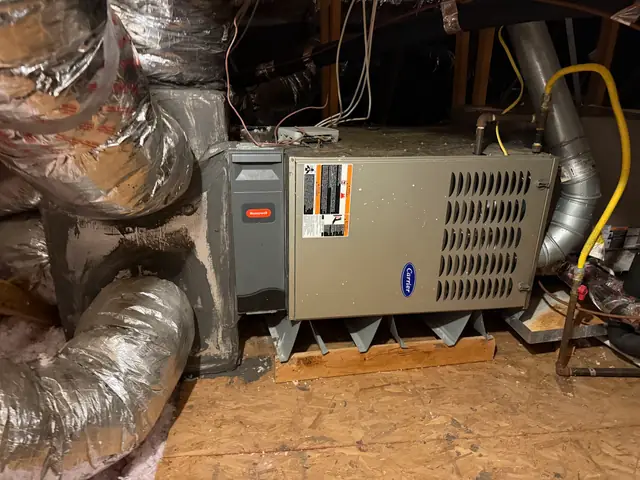
What a duct check usually turns up
The equipment can be sized right and still lose to the ductwork around it. A few things show up often enough in this area that they are worth checking before anything gets replaced:
- Static pressure higher than the system was designed for, usually traced back to a return that is undersized for the equipment pulling air through it.
- A flex run crushed against a truss or kinked in the attic, cutting airflow to whichever room sits at the end of that branch.
- Insulation that has thinned out or gone missing on a run, in an attic that regularly sits well above the temperature of the rest of the house.
- Condensation on the outside of a duct where humid indoor air meets a cold surface, a common sight in Gulf Coast summers.
- A damper or zone board stuck in the wrong position, sending conditioned air somewhere it is not needed while another room goes without.
Some of that is a repair. Some of it is a case for new duct installation instead of patching an undersized run again. Either way, it is worth ruling out before assuming the equipment itself is the problem. See every service on the services page, or read how zoning and smart thermostats fit in once the duct system itself is sorted.