What Actually Breaks on a Texas AC in August, and What It Costs to Find Out
The heat doesn't break your AC directly. It just finds whatever part was already weak.
August 25, 2026 · 4 min read
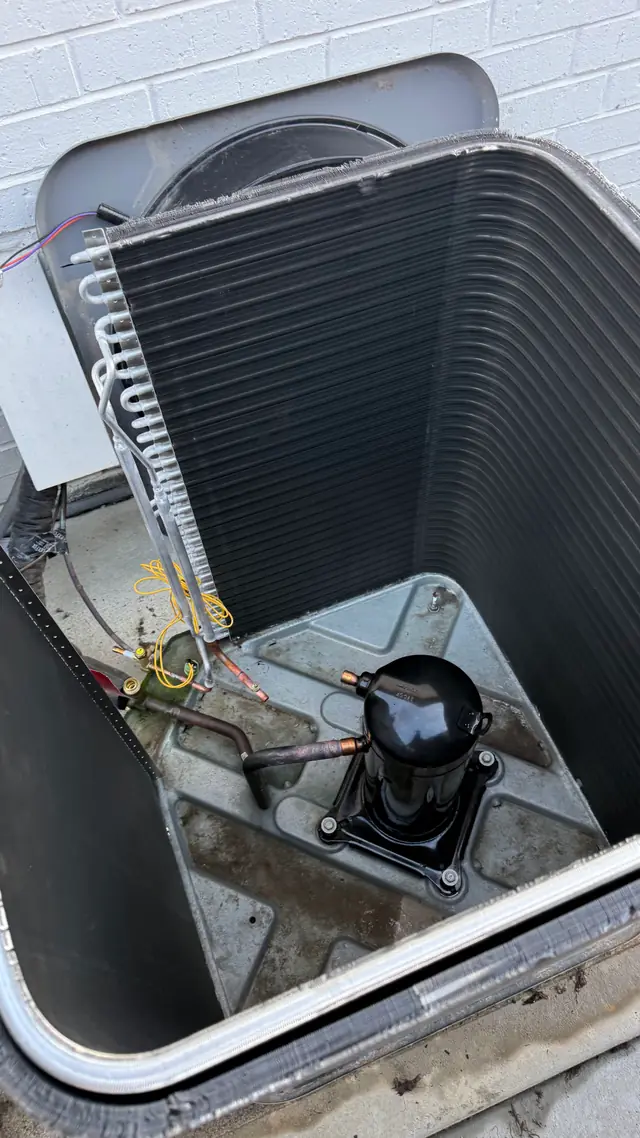
There's a pattern to when air conditioners fail around here, and it isn't random. Late July through August is when the phone rings the most, not because heat breaks equipment directly, but because sustained high load finds every part that was already running on borrowed time. A capacitor that was fine at 85 degrees outside temperature gives out at 101. A contactor that's been arcing quietly for a year finally welds shut. The heat is the trigger, not usually the actual cause.
The cheap failure: the capacitor
A run capacitor is a small cylindrical part, often not much bigger than a soda can, that gives the compressor and fan motor the extra push they need to start and keep running smoothly. Capacitors degrade with heat and age, and a system that's been fine all spring can have a capacitor that's just barely getting by. In extreme heat, when the compressor is working its hardest and the outdoor unit itself is sitting in full sun radiating heat back at its own components, a marginal capacitor finally gives out. This is one of the cheapest, fastest fixes in the trade, a straightforward swap once diagnosed. The catch is that a failing capacitor can look identical from the outside to something far more serious, a system that just hums and won't start, so it genuinely needs a tech with a meter rather than a guess.
The mid-tier failure: contactors and fan motors
A contactor is the electrical switch that turns the outdoor unit on and off every time the thermostat calls for cooling. Every cycle, it makes contact under load, and over years that contact surface pits and burns. Eventually it either sticks closed, running the unit constantly, or fails to close at all. A condenser fan motor is a different kind of wear item, a bearing and winding that just runs down with hours logged, made worse by a Texas summer where the unit barely gets a rest between cycles. Both are more involved repairs than a capacitor, parts plus labor, but still well short of a system replacement.
The one that gets blamed for everything: low refrigerant
A surprising number of August service calls that start as "my AC isn't cooling" turn out to be refrigerant related, usually a slow leak that's been present for a while and finally dropped the charge low enough to matter under peak load. This one is worth being direct about: a system doesn't just run low on refrigerant from age or heat. It's lost through a leak somewhere in the coil or line set, and topping it off without finding the leak is a temporary fix that just brings the same call back next summer.
- Weak or warm airflow at the vents, but the outdoor unit is running
- Ice forming on the indoor coil or the refrigerant line
- A hissing or bubbling sound near the outdoor unit
- Cooling that used to hold steady now cycles on and off constantly
Why a same-night call matters more than people think
In a Gulf Coast August, a house without cooling isn't just uncomfortable, it climbs fast, and for anyone with young kids, older family members, or pets in the house, a next-day appointment can be a genuinely rough night. One recent review for Prime Texas Air described exactly that situation, an AC that stopped working late in the evening, and a technician who was still able to come out and get it running the same night. That's not always possible depending on call volume, but it's the standard worth asking about when you're choosing who to call.
The honest advice here is simple. Don't try to diagnose a hot house yourself past checking the thermostat batteries and the breaker panel. The difference between a capacitor and a refrigerant leak isn't visible from outside the cabinet, and guessing wrong usually means paying for a part that wasn't the problem.
Residential and commercial fail differently in the same heat
A home AC and a commercial rooftop unit are fighting the same August sun, but the failure patterns aren't identical. A home system usually runs on a set-and-forget schedule, cooling to one thermostat's call, so a weak capacitor or a tired contactor tends to surface as an obvious no-cool event, the house just stops getting cold. A commercial packaged unit on a restaurant or retail roof cycles far more often through the day, doors opening constantly, equipment loads changing, and it's carrying that duty cycle on top of direct roof-level heat that can run well above the ambient air temperature. That extra cycling wears contactors and capacitors faster, which is part of why commercial units tend to need attention more often even when they're newer than the house down the street.
What actually helps before the heat peaks
A spring tune-up doesn't prevent every part from wearing out, but it catches the ones already close to the edge, a capacitor testing low on capacitance, a contactor with visible pitting, a fan motor drawing more current than it should, before 100-degree days force the issue at the worst possible time. It's the difference between replacing a capacitor on a technician's schedule in April and replacing one on your own schedule, meaning whenever the house happens to get unbearable, in August.
Prime Texas Air, (832) 586-6884
Call (832) 586-6884More articles
Your Walk-In Cooler Is Drifting Warm. Here's What to Check First
A cooler that's a little warm today is telling you something. Catch it before it's a lost inventory night.
What Actually Happens When a Nest Install Trips a Fuse
One wrong wire on a smart thermostat swap and the whole system goes dark. Here's why.