The Upstairs Room That's Always Hot Isn't a Broken AC. It's a Zoning Problem
A single thermostat can only be right for one room. Every other room is a compromise.
August 25, 2026 · 3 min read
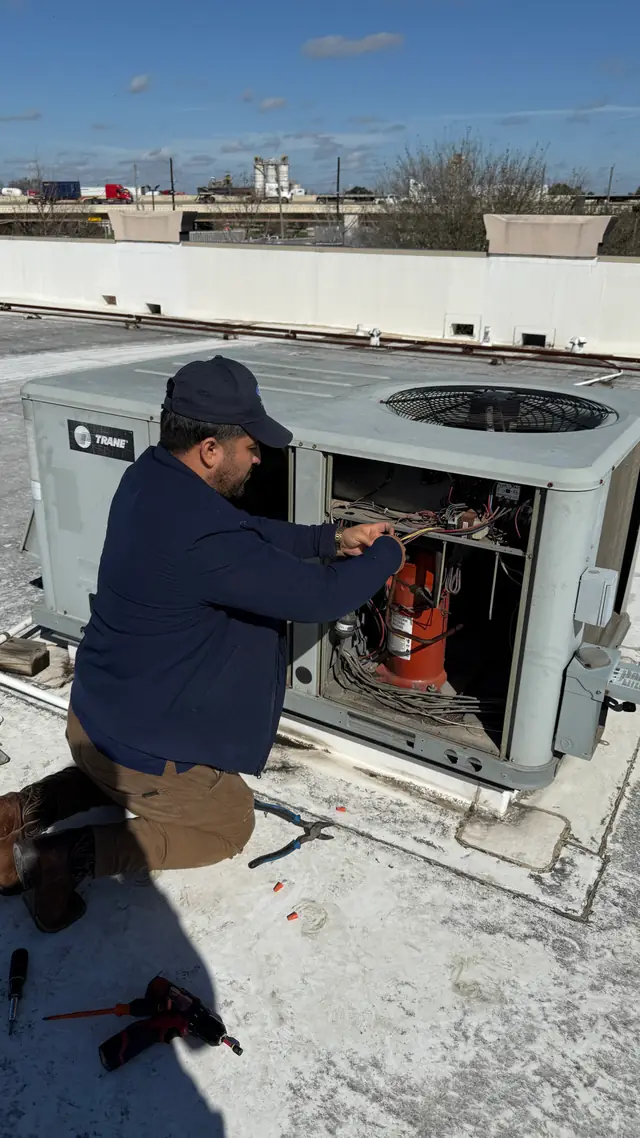
Almost every two-story house in this area has one. A downstairs living room that's always comfortable, and an upstairs bedroom, usually a corner one facing west or south, that runs several degrees warmer no matter how low the thermostat gets set. The usual response is to assume the AC is undersized, or losing capacity, and start pricing a new unit. In a lot of these houses, the equipment is fine. The problem is that one thermostat is being asked to represent the temperature of an entire house, and it can only ever be exactly right in the room it's mounted in.
Why upstairs runs hotter, physically
Heat rises, so the upper floor of any house starts warmer than the ground floor before the system even runs. Add a Texas summer, where the roof deck is absorbing direct sun all day and radiating that heat down into the attic and the rooms just below it, and upstairs rooms are fighting a heat load that downstairs rooms simply don't have. A single thermostat, almost always mounted downstairs, calls for cooling based on the temperature where it sits. Once that spot hits the set point, the system shuts off, whether or not the room upstairs actually reached comfortable temperature yet.
What zoning actually changes
A zoning system splits the ductwork into sections, each with its own motorized damper and its own thermostat or sensor, so upstairs and downstairs, or any other split that makes sense for the house, can call for cooling independently. The equipment doesn't change. What changes is that the system can keep running for the upstairs zone after the downstairs zone is already satisfied, instead of shutting off the moment one sensor reads comfortable. It's a control change, not a capacity change, and it's usually a fundamentally different fix than what a house actually needs when the real complaint is one room, not the whole system.
Things worth ruling out first
Zoning isn't always the answer, and it's worth checking the cheaper possibilities before committing to it. A supply duct that's poorly balanced, with too little airflow reaching the upstairs registers to begin with, can cause the same symptom and costs far less to fix than a full zoning retrofit. Attic insulation that's thin or has settled over the specific hot room can also be a major factor on its own. And ductwork running through that superheated attic space, covered in the piece above, compounds all of it.
- Check that upstairs supply registers are fully open, not partially closed from a prior season
- Feel for weak airflow at the upstairs vents compared to downstairs
- Ask whether the upstairs ductwork or insulation has ever actually been inspected
- Only then consider zoning as the fix for a persistent room-to-room gap
A realistic way to think about it
One thermostat can only ever be right about one place. Everywhere else in the house is a compromise built on the assumption that the rest of the rooms behave similarly to the one the thermostat is mounted in, and in a two-story Texas house with a hot upstairs corner room, that assumption usually breaks down by June. Prime Texas Air installs custom zoning systems as part of its residential air quality and system upgrade work across The Woodlands and the surrounding service area, and it's a conversation worth having before assuming the fix has to be a bigger, more expensive unit.
How the dampers actually behave day to day
Once a zoning system is in place, the change is mostly invisible in daily use. A sensor in the upstairs zone calls for cooling, a motorized damper in that branch of ductwork opens, and the system keeps running for that zone specifically, even if the downstairs zone already hit its own set point and its damper has closed. A bypass damper or variable-speed blower handles the airflow difference so the system isn't straining against a mostly closed duct system when only one zone is calling. None of this requires a homeowner to manage anything manually day to day, it runs the same as a single thermostat always has, just with the actual physics of the house accounted for instead of ignored.
The rooms that benefit most are the predictable ones, upstairs bedrooms, rooms with west-facing windows catching afternoon sun, bonus rooms over a garage with less insulation around them than the rest of the house. If one of those describes the room that's always the complaint in a household, that's usually the strongest sign zoning, not a bigger unit, is the fix that actually solves it.
Prime Texas Air, (832) 586-6884
Call (832) 586-6884More articles
Your Walk-In Cooler Is Drifting Warm. Here's What to Check First
A cooler that's a little warm today is telling you something. Catch it before it's a lost inventory night.
What Actually Breaks on a Texas AC in August, and What It Costs to Find Out
The heat doesn't break your AC directly. It just finds whatever part was already weak.